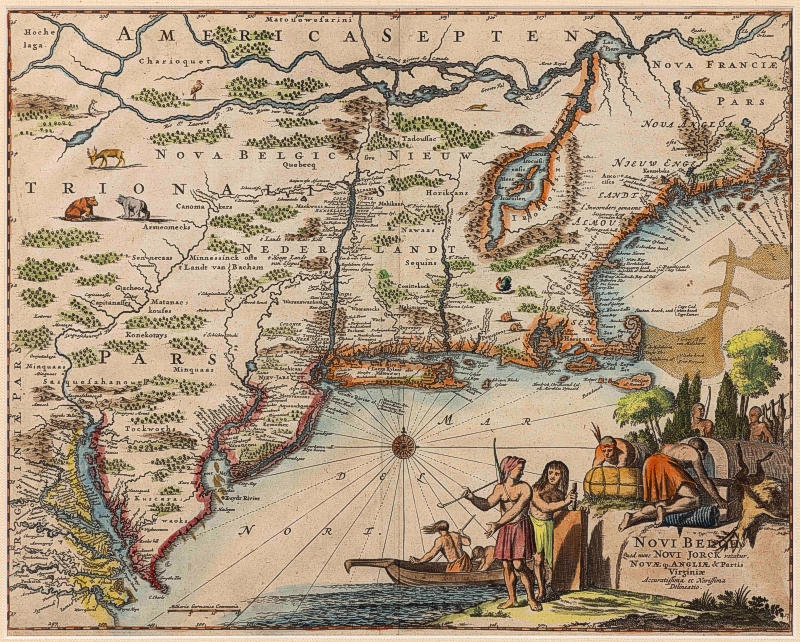
Map of New England, New York, and Virginia, by Arnoldus Montanus, 1671.
Publicly, we sold memories under Quimbly, Barrett & Woods, but when it was just the three of us, working late into the night, we thought of ourselves as mapmakers. There was something nautical about the loft we’d rented: the massive oak beams and triangular plate glass window that stood like a sail at the end of the room. In the day it showed us the tar-papered roofs of neighboring apartment buildings, and at night it revealed the illuminated Brooklyn Bridge and Manhattan’s skyline. We called it The Crow’s Nest, and we were the captains, lording over the memories of the world as we drew our maps into our programs. Here was the ocean, here the ships, here the hotel, here the path that led to town, here the street vendors, here the memories of children we never had and parents much better than the ones we did. And far out there was the edge of the world.
What happens when you get to the edge?
You fall off, we joked.
Early on there were many edges. They existed within our restaurants and hotels as well as the borders of our cities. Most of our hotel rooms were well-charted—open the drawer and you’d find a Bible, take the paintings down and there’d be more wall—but behind the closed doors of neighboring rooms there was nothing but white light. There are, of course, the Japanese maximalists, like the legendary Shimazaki, who design every carpet fiber of every hotel room to avoid any edges, but what Quimbly, Barrett, and I found was that most people trusted memories like they trusted films. You beam a movie between your eyes and remember the plot in vivid detail; you don’t wonder where a sidekick’s parents live. When you beam a vacation, you remember swimming at the beach and caipirinhas in coconut shells, not the unexplored outskirts of town. Granted, if a tourist tried to remember swimming far enough, say past the ships, had they gone further than the edge of town, up a highway, stepped onto the dirt roads at the edge of the map, they’d see that place where the ground ended and the white light began, but people were happy with their memories. What they wanted was a family trip that went well. They wanted the feeling of skydiving to tingle their bones. They don’t care about the rivets and bolts of the plane they jump from; they merely want to remember that the pilot’s name was Chip, that he patted them on the back, that he said nice jump.
What the populace wanted, what they still want, what they’ll always want, is pulp cybernetics. Perhaps not as cheap as the corner-store memories China’s producing—$8.99 porn thrills, so poorly constructed you can see the patches of light where the hardware burns through the girls’ skin—but give them palm trees, a restaurant with an attractive server, coral reefs and sand dollars for the kids, and you have a package that retails for $79.99.
*
It was shortly after Circuitry did the article on us that Quimbly began experimenting with bad memories. It was a natural progression for him. He specialized in emotional recollections: childhoods, marriages, and adolescence. He’d always cringed from anything Hallmarky—the happy marriages and quintessential childhoods—puppies and kittens as he called them. His first generation of memories all contained some element of sadness within them: grandchildren for the childless elderly, losses of virginity to lonely men who’d never known love. But there was something truly sinister to Quimbly’s second batch. He sold heroin addictions to artists wanting darker aesthetics, affairs to couples who’d never cheated on one another, gunfights to rappers, and suicide attempts to Goth kids.
It was to get away from the dark energies Quimbly was manufacturing that I ended up meeting Cynthia. She was sitting in the coffee shop across from the office where I’d go to get my coffee, clear my head, and work on constructing my own happier memories. There was no computer or phone in front of her, only an open journal which she leaned over in concentration. I was fascinated. I hadn’t seen anyone using a pen since college, and even then it was mostly older professors who’d used them. She was in her thirties, with long brown hair and flushed cheeks, and every now and again she rested the pen against her bottom lip as she tapped her sandaled foot against the table. If her pen hadn’t run dry, she probably never would have seen me.
“Hey,” she said.
“Me?” I asked stupidly; there was no one else around.
“Yeah, you. Do you have a pen?” She held hers in the air. “This one’s done for.”
“Sorry,” I said, and looked back at my laptop, wishing I wasn’t such an idiot around women. Say something, I told myself, and so I looked back up and said “Hey.” She raised her eyes. “I’ll go ask if the barista has one.”
It turned out he didn’t. I walked back to her table. “Sorry,” I said, “no luck.”
“Doesn’t surprise me.” She closed her journal.
“What are you writing?”
“Memories,” she said and pointed her pen at my laptop. “What about you?”
“Pretty much the same. It’s my work; I make memories. Maybe you’ve heard of us? Quimbly, Barrett & Woods?” She shook her head. “We’re in a lot of blogs right now.”
“I don’t read blogs,” she said. “I try to stay disconnected.”
“You’ve heard of beamed memories though, right?” She shook her head again. “Well, I’m Adam,” I said and extended my hand.
“Cynthia,” she said.
“I could show you what I do, if you’d like. Our workshop’s just across the street. I’m sure there’s a pen there.”
She put her journal in her bag. “Sure,” she said. “Show me your memories.”
*
Cynthia kept me out of the office that weekend. It’d been a long time since I’d been with anyone, and never with someone like Cynthia. When we lay in bed together, I could feel the loneliness of my previous life, filled with computer programming and take-out containers, giving way to the happiness of a future together. In short, I was falling in love.
I called in sick Monday and stayed in bed with her, afraid that if I left she’d disappear. It was the first time in months that I didn’t work on constructing memories. Instead, I let my mind fill with details of her: what her lips felt like, the timbre of her voice when she said my name, the way morning spread across the bedroom, how I’d forgotten what happiness felt like.
When I finally returned to work on Tuesday and told the guys, I got ribbed by Quimbly. “So that’s what happens when you get laid?” I shrugged and blushed. “Thought you’d both left me,” he said. “Barrett’s lost in the Bible.”
Barrett was sitting by his computer with his head down, the golden-rimmed pages of a King James on his desk. He’d found his niche with religious experiences. “What are you doing?” I asked him.
“Shhh…” he said darkly and didn’t look up.
“He’s writing Sunday sermons now,” Quimbly said. “Turns out folks are just as happy thinking they’ve been to church than actually going. Barrett, put that fucking Bible down, we’ve got something serious to talk about.” Barrett raised a bloodshot glare from the book before marking the page and rising.
We’d gotten our first complaint. A tech-savvy grad student had intentionally gone seeking the edge. He’d tried to remember driving to the border of the Mexican town we’d created for Spring Break and had run into the white light. His blog posts were already circulating the Internet.
“We haven’t been designing tight enough memories,” Quimbly said.
“The kid went searching,” I said defensively; it’d been my memory. “We can’t control where our users go.”
“Maybe not, but we can test each other’s memories,” Quimbly said. “From now on, before we release anything for sale, you go into Barrett’s memories, he goes into yours, and both of you go into mine. You test out the edges. Search every alleyway, open every door, drive as far as you can. You find the edge of a memory, you fix it. Go ahead and test at home if you want, just make sure you log every beam.”
“And what are you going to do?” I asked.
“I’m the control group,” Quimbly said. He promised to watch over us and hold our memories straight. “Don’t worry,” he said, “I’ll keep your brains from getting fried.”
*
The problem with testing memories was that after enough blasts it became impossible to recognize the difference between authentic memories and beamed ones. Had I really fought in Afghanistan? Cynthia was lying next to me in bed, reading a book. It was one of her things—she read actual books. Where she found them, I have no idea. But there she’d be, pillows propped behind her head, reading a novel word by word, page after page, taking endless hours when she could’ve had the thing memorized in minutes.
“Was I ever in Afghanistan?” I asked.
“You weren’t born yet,” she said dryly.
“How about Bermuda?”
She lowered her book onto her knees and shook her head. “The last place you actually went to was your parents’ house for Thanksgiving.” It was February. I tried to remember back to November, the dinner with my parents; but it seemed less real than my memories of the tropics.
“Are you sure?” I asked.
She raised her book. “Yeah, I’m positive. You’ve got to stop beaming.”
Cynthia was vegan and almost entirely anti-tech. She was devoted to causes like buying back land for Native Americans and safeguarding water rights for third world countries. Though I supported her causes, I resented that she never praised my work. “You know that indigenous tribes are buying our memories, right?”
She let out a heavy sigh. “I’m not trying to put down your work,” she said. “But you’re spending more time trying to figure out memories you never had than making real memories with me. You’re getting addicted.”
This wasn’t entirely true. In those first months together, I’d go to the Crow’s Nest and work on memories during the day, then take nights off with her. A bistro had opened near my place, and we’d go there on the weekends for breakfast. Nights we’d order in Chinese, lie in bed, and make love. But Cynthia was right. There were many times when she’d catch me staring out the window, trying to find the edge of Quimbly’s latest memory.
At work, Quimbly, Barrett, and I focused on making our memories last longer. The key was to package memories together. A vacation to Europe couldn’t simply be the Eifel Tower and the Louvre, it needed to involve the airplane ride, the week at work before, the mundane details which helped make the memories stick.
“All good memories have boredom buried in them,” Quimbly told us one night.
“You should write children’s books,” I said.
Barrett was unusually quiet. He’d grown more silent ever since he’d begun designing past-life memories, and we mistook his silence for Zen satori rather than the madness that was slowly taking his mind.
“Look, if we make perfect memories we’re not going to have customers left,” Quimbly said and leaned over the coffee table. “The key to our success is to give people ninety-nine percent perfect experiences. Make them almost happy and they’ll keep buying. Trust me on this.” Then he gave us the next batch of memories to test.
*
Cynthia hated Quimbly from the first time they met. I’d invited Quimbly for dinner in hopes they’d get along, but by the time we sat down to eat, it was a mess. Cynthia was working on a clean water project for African children and, in typical Quimbly fashion, he started an argument. “Look, I get you, it’s good to give them water, but let’s be honest, water isn’t going to change their history. Give them memory sticks and at least they’ll have happy memories before they die.”
“That’s really sick,” Cynthia said.
“You’re telling me if you could give them a happy childhood, you’d deny them?”
“It’s not a happy childhood; it’s forgetting their actual past.”
“I think you want them to suffer,” Quimbly said. “Somehow their pain makes things real for you.”
I tried to sooth the tension, suggested we do both, send them water and memories. Getting the kids water made sense, I said, it was the right thing to do, but I didn’t see any harm in giving kids good memories as well.
“Fuck that,” Cynthia said. “What you’re talking about is making a bunch of beam-heads who won’t ever work for social change.”
“That’s not true,” I said. “We’re designing parents for inner city kids with horrible upbringings; we’ve donated memories to the poor.”
“That’s not social change,” Cynthia said, and got up from the table, leaving her dinner unfinished. “I hope you know the work you guys are doing is evil.”
Quimbly took a sip of wine and gave me a smile after she left the room. “You sure she’s the one?” he asked. “You might want to take a closer look there, buddy.” He stayed long enough to finish his dinner and fix himself another drink, and then, when I said it was probably best I see him tomorrow, he left. I cleared the dishes from the table and went into the bedroom, where Cynthia sat reading.
“I can’t believe you work with that asshole.”
“You guys didn’t get off to the best start,” I admitted. “He’s actually a good guy; he just likes to push people’s buttons. He’s a brilliant designer.”
“That kind of brilliance I can do without.” She looked at me for the first time since I’d entered the room. “His fetish is getting inside people’s heads. That’s why he likes being, what did you call it, the control group? Control freak is more like it. He loves that he controls your memories—you’re his guinea pigs.”
In retrospect, I can see that this was precisely what Quimbly was doing. I’d thought of him as a friend—and maybe Barrett and I were as close to friends as Quimbly would ever be capable of—but, deep down, we were just social experiments to him. I couldn’t see it then however, and was angry at Cynthia for calling our work evil and me a guinea pig.
“It’s no different than what you do,” I said before I could stop myself. “You only want real memories, memories you get to hold onto and no one else. You talk about our future and all the memories we’ll have. You plan for a farmhouse that doesn’t exist.” I sounded exactly like Quimbly. “You like controlling my memories as much as he does.”
She looked at me for a moment before turning back to her book. “You don’t have a fucking clue what you’re talking about.”
“Right,” I said. “That’s why I have a company worth millions, and you’re just reading a book.”
“Here,” she said, tossing me a pillow. “How about we sleep apart tonight.”
And so I went back into the living room and lay on the couch, late into the night, wondering why I’d defended Quimbly against the woman who loved me. Perhaps this proved everything Cynthia was trying to tell me—that he’d already gotten so deeply into my head that I’d willingly hurt anyone who reminded me, not out of control but out of love, that I’d never been to Russia or had a brother. It was this thought that brought me back to the bedroom, to climb beneath the sheets, and to hold her, telling her I was sorry, and that I wanted to make memories together.
*
It was hard to shake the memory of our first real fight. In the months that followed, Cynthia and I avoided that night with Quimbly, and I made an effort to be more present. We went for walks, ate at our favorite bistro, and we’d return to my apartment and make love. But there was a growing distance between us, and when she’d fall asleep, I’d edge my way out of bed to beam memories in the darkness of the bathroom. It was, I realize now, a time when I had everything: a woman who loved me, a company worth millions, and bidders waiting in line to buy us out. Quimbly was calling us the history-makers. It was a time when I believed we would become the masters of the world. Then we destroyed it all.
“We’ll make a fortune,” Quimbly said, putting his palms together.
“What exactly are you suggesting?” I asked.
“Simple ad placement. We layer one into your Cuba memory. Show sweat beading along a glass of Coke, carbonation fizzing. We’re talking big money for a single placement.”
Barrett was deadly silent. Over the past weeks he’d become increasingly taciturn, but this was something different. His lips were working back and forth against each other as though he was grinding his teeth.
“We’re selling out?” I asked.
“Just being practical. They’re lining up at our door. We could own the world.”
“Enough!” Barrett ordered, his voice echoing in the beams.
“Hold on,” Quimbly said, “You haven’t heard me out.”
“You dare argue with me?” Barrett boomed, his fingers clenching. “Do you know who I am? I am the Lord of lords and the King of kings; I am the alpha and omega. I am the Lord Supreme.” He rose from his seat, stepping onto the couch and lifting his hands into the air as though holding a staff. “You, who sew discontent, shall be crucified! Your hands and feet shall be cut off—”
“Barrett, chill,” Quimbly said.
“In my presence the mountains quake! The hills melt, the earth trembles, its people are destroyed! The day of judgment has come!” Then Barrett jumped from the couch and seized Quimbly around the neck so hard it left bruises for weeks after. It was when I saw Quimbly’s face turning blue that I took my beer bottle and broke it over Barrett’s head. We tied his legs and arms together and called 911.
That was the end of Barrett. He was sent upstate, where he ranted at the walls and played God to anyone willing to listen. When we cleaned out his apartment, we discovered the memories he’d never told us about. He’d begun a personal log which detailed beaming thousands of his own created memories; the notebook deteriorated into pages of an indecipherable alphabet.
Still, Barrett had tried, in his own way, to warn us. Come May, less than a week after our first memory ads launched, the word spread that we’d sold out. A blogger posted a scathing piece that went viral. Memory startups took the bait and began selling their memories as “100% ad free.”
“Who’d have guessed they’d resent having their brain space tweaked, they never seemed to mind before,” Quimbly joked. But he, too, was shaken. Within the month, sales fell and our inboxes were full of hate mail. We were no longer the masters of the universe, just owners of a failing company.
*
Quimbly ended up taking a job for another company that manufactured thought-ads. He told me the news as we cleared the Crow’s Nest of our belongings, and I listened vaguely as I cleaned out my desk, realizing the life we’d created together was now only a memory. Barrett was gone, Quimbly was moving on, and I had nothing but my dwindling savings and Cynthia.
“People resist thought ads, but soon enough they’ll be as commonplace as napkins,” he said. “I can get you in, but first clean yourself up.”
I looked up from the floorboards where I’d been staring, thinking about the years I’d spent in the war. “What do you mean clean myself up?”
“How many memories are you beaming a day?”
“Not that many,” I lied. Like Barrett, I was designing my own memories and downloading them when I couldn’t sleep. I still logged the memories I tested, but not my late night binges or the hundreds of high-end Shimazaki memories I’d spent my bank account on. “Maybe a few a day,” I said.
“Uh-huh. Look, I’m not telling you what to do with your life, but you’re starting to act like Barrett. Go visit him. Refresh your memory of what happens when you lose track.”
“I’m fine,” I said.
“No, you’re not,” Quimbly said. “You probably don’t even remember the time we went skiing.”
“Of course, I do: Breckenridge; three days of fresh powder.”
Quimbly shook his head. “That was one of mine,” he said. “Listen, I know you won’t stop beaming because I tell you to, but if you’re going to keep beaming, at least use this one next.” Quimbly pulled a memory stick from his pocket. “It’s a going-away present.”
“Thanks,” I said, and though I knew he and Cynthia were right, and that the best thing for me would be never to touch another memory again, I couldn’t help myself from reaching out and taking the gift.
When I got back to the apartment, I left the boxes from the office in the hallway and sat down on the couch. I placed the tip of Quimbly’s memory stick against my forehead and pressed the button. I was halfway into the beam when Cynthia walked in.
“You’ve got to be fucking kidding me,” she said.
“What?” I opened my eyes.
“You just went bankrupt because of those things and you’re—” Then she stopped. “No, you know what—go ahead and enjoy yourself, beam all night if you want, I’m out of here.” She raised her two fingers into a peace sign then turned her back on me and left the room.
“Hey!” I said. “Just wait a minute, I’m almost done.” I finished Quimbly’s gift and got up to find her, but she wasn’t anywhere. Not in the bedroom, the kitchen, or the bathroom. The only trace of her was a note taped to the mirror. I’m done. Goodbye, Adam. Thanks for the memories. Sorry you liked yours better.
For the next two weeks I binged on memories to keep from letting the pain sink in. I went to the Himalayas and gambled in Vegas, I slept with porn stars and got wasted with celebrities, I drove in stretch limos through Hollywood and sat on the beaches of the world watching sunrise after tropical sunrise, beaming one after another memory, until one morning I found myself in the early light, dehydrated, shaking and sweaty, without a clue of who I was.
Did I have parents? Were they both still alive?
In one memory I recalled attending their funeral. In another I pictured them tanned and happy in L.A. And in yet another I remembered our childhood home in Tibet. I scrolled though my phone, my grip sweaty and slippery, until I found a number listed as Home.
A woman picked up on the third ring.
“Hello?” she said, her voice distant and unfamiliar.
“Mom?” I asked. “Can I come home?”
*
My life since leaving the memory business has mostly been recovery and learning to forgive Quimbly. I work to get my memories straight. I’ll recall my parents’ death, envision myself as an angry teenager, smoking cigarettes in the Rockies after their funeral. Then I’ll hear the floor squeak above me, hear my mother in the kitchen, listen to my father cough before he lets the door slam, and I’ll remember that I never lived in Colorado but grew up here in Brooklyn. I live in my parents’ basement again, like when I was a teenager, and I never smoked cigarettes, merely spent my daylight hours in this subterranean darkness programming computers.
I got a job at a coffee shop in the neighborhood where I help curate the art on the walls and brew lattes for the kids who are settling this outpost of New York City. And I work on my letter to Cynthia. I sit, pen in hand, trying to remember what love felt like. I miss you, I write. I’m better now. I want to make real memories together.
Quimbly saved me, there’s no doubt about that. Had I never fallen in love with Cynthia, she never could’ve left me; had she never left me, I never would’ve stopped beaming. Typical though, that even Quimbly’s acts of kindness were sadistic. It was when I’d finished my letter that I understood his real gift had been motivation, not merely memories. Sealing my pages into the envelope, I picked up my pen to write Cynthia’s address, and realized I had no clue where she lived. Every memory I had of her involved my apartment, the bistro, or walking the streets in winter. Hadn’t I ever seen her apartment, I wondered. And then, before I could stop myself, I understood that I’d found the edge. Light poured through the cracks where stories of her family should’ve been. It came streaming in from the hallway of my old apartment, which had never been clean, but was a dark, curtained cave, filled with take-out containers and an unmade bed. The bistro where we ate never had a name; the Chinese take-out never had fortune cookies. And yet, all the other details had been masterfully placed, every memory bunched together to form a life that had never happened. I sat there in the coffee shop, the light fluttering behind my eyelids, feeling my heart sail off the edge of the world.
Love scars memories, even if it was never real. When I walk the streets I think: we walked here together, she used to touch my arm like this, and the pain of white emptiness sets in. You can’t get rid of memories; you can only try to ignore them. I’ve been weeding through my old notebooks, finding the edge of the world in one after another memory. I was never in France or Tokyo, have never seen the California Redwoods or swam in the Caribbean, and I’ve never made love with Cynthia. All the same, I keep working on my letters to her. I tell her I can still remember her skin against mine as we slept, the light in her eyes when I’d open my apartment door for her, and the sound of her voice, telling me, over and over, just how much she loved me.

Alexander is the founder and Director of the Martha’s Vineyard Institute of Creative Writing and the author of the short story collections Universal Love and Children of the New World, which was chosen as a New York Times Notable Book of the Year, and a best book of the year by NPR and Electric Literature. His fiction has appeared in Best American Science Fiction & Fantasy and Best American Experimental Writing. His short story, “Saying Goodbye to Yang,” was adapted as the film “After Yang” by A24 Films, and was the recipient of the Alfred P. Sloan Prize at Sundance, the Boston Society of Film Critics Award, and Barack Obama’s Best Films of 2022.