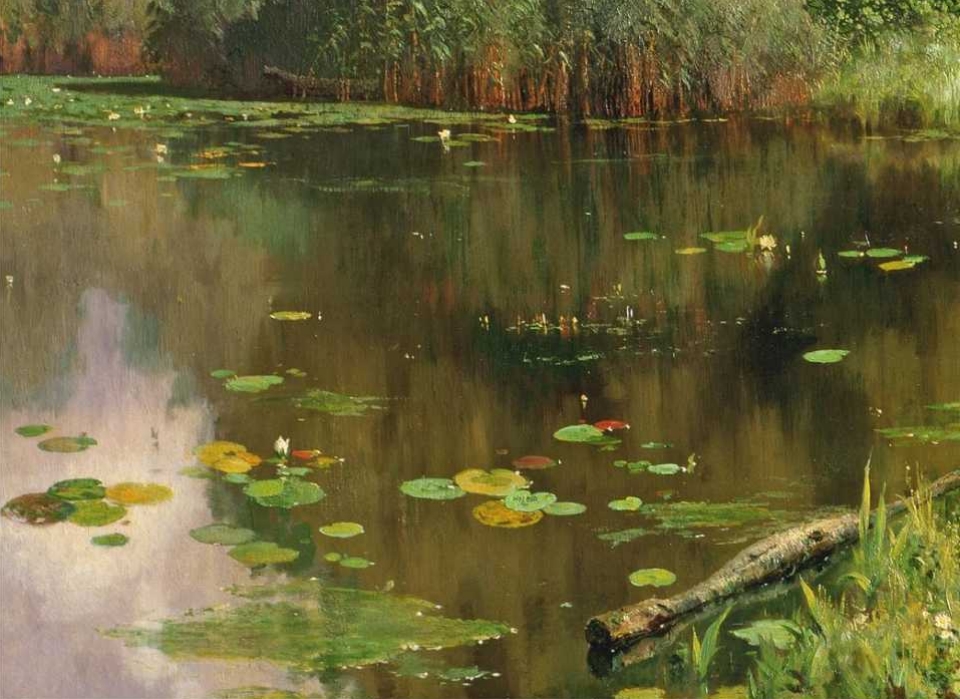
“An Overgrown Pond (detail),” oil on canvas, by Vasily Polenov, 1879.
The city drained the quarry and closed the park for the search or rescue or recovery or whatever, so naturally after dark we snuck through the empty parking lot and under the gate arm and down the narrow gravel, Cassy and me. We didn’t wear swimsuits because the water was supposed to be all gone, and who’d want to swim in dead-ten-year-old-kid soup anyway?
The night was its own hot soup. The mosquitos needled us while we traced the path that wrapped between young trees around the quarry we’d floated upon in tractor tire innertubes all summer. We’d turned fourteen within a week of each other, Cassy and me, and shared an August birthday party out here. Everybody jumped off the thirty-foot-tall cliff except me. Classmates and respective cousins, some mine, some Cassy’s, promised me there were no deadly boulders under the surface and demonstrated so again and again by soaring off the edge and exploding into the water below before resurfacing a terrifying ten or more seconds later. I couldn’t admit to them that meeting nothing but water, down and down and down, was what I feared, not boulders.
Now, the drained quarry was a vast, jagged mouth that seemed to go down forever because we hadn’t thought to bring flashlights, and honestly, even if we had, their beams would never have reached the bottom. A halfmoon lit one blurry cloud way up above and cut silver outlines out of the pumps and hoses and excavator that sat on the floor of the quarry among black patches of mirror water.
Cassy said as we squinted down into the dark that her dad thought he used to go to church with the parents of the missing kid, except he wasn’t one hundred percent sure, because it was a common first name and a common last name, and Cassy’s dad didn’t go to church anymore anyway. I stunned myself by forgetting the disappeared kid’s name. Lucas Wilson. Liam Williams. Cameron Walker. Something with that same blond baseball player flavor. I asked Cassy, and she didn’t remember the name either, but she didn’t seem too shocked about it. She was four inches taller than she had been at the start of the year. All lithe, never shocked about anything. Why didn’t her dad go to church anymore? I wanted to ask, but my parents had never gone to church, so what would I know about it anyway? Had Cassy ever gone to church? Did she believe dead kids who drowned in quarries went somewhere else afterward? But Cassy and I didn’t ask each other things. We just went looking and stood before jagged, damp, vacant enormity and talked about whether dead kids floated or sank.
That summer, cheered on by Cassy and our shared partygoers, I’d trotted toward the edge of the cliff intending to launch myself off, but the hungry water droned up at me from below, its greed so loud it shrank me and chased me scrambling back from the edge. That humming vertigo was the inverse of this drained-quarry-at-night vertigo, which instead of shrinking me made me crave sailing off the edge, like freefalling a hundred feet into slimy, rough granite was welcoming compared to deep, unknown waters. Maybe he was down there in some undiscovered cranny. The kid. Colton Anderson. Landon Adams.
Cassy wanted to find a better vantage point down into the pit, so we strode on along the ledge. We had talked for days about the kid who disappeared in the quarry, about how the city had pumped the water out and probably killed the fish, about how thrilling it would be to explore this alien version of the park after dark and maybe, just maybe, catch the police or paramedics or coroner pulling a soggy Levi Watson or whatever his name was from the slick rocks he surely rested among. She didn’t ask me if I actually hoped we’d see this kid corpse. And I didn’t ask her if we were out here because we were envious and wished we could disappear, too.

Jessica Jo Staricka grew up on a dairy farm in Minnesota. She earned her MFA in Creative Writing at the University of New Orleans. Her work has appeared in Fourteen Hills, Beloit Fiction Journal, X-R-A-Y Literary Magazine, and elsewhere. When she isn’t writing, Jessica can be found drawing or exploring.